Somewhere I read that you should have controversial content on your web pages. I am still debating about this one. I don't want to be labeled. After all, I will be looking for a job after I finish school.
| Privacy on the Internet | |||||||||||||||||||||||||||||||||||||||
This one drives me crazy. I never gave anyone permission to share my information and yet it is everywhere. Not only is my information out there, but my relatives are linked to my name as well. Why isn't there laws against this. It is a violation of my privacty and it is dangerous. Here are some of the things that took me a lot of time to learn. I put them all together so you don't have to search the entire web to try to win back your privacy.
|
|||||||||||||||||||||||||||||||||||||||
Privacy Information Privacy on the Internet seems to be a big problem. The following Web sites provide information about online privacy issues, including information about privacy tools such as encryption, anonymous remailers and software for anonymous browsing: http://www.cdt.org/privacy/pet/ Coalition Against Unsolicited Commercial Email (CAUCE) Canada www.cauce.ca Pourriel Canadawww.pourriel.ca Canadian Marketing Association / Association Canadienne du Marketing www.the-cma.org |
|||||||||||||||||||||||||||||||||||||||
Who are the culprits? There are so many, I can't list them all here. This is a small list of the top offenders. Intelius.com |
|||||||||||||||||||||||||||||||||||||||
How to remove your information
|
|||||||||||||||||||||||||||||||||||||||
GlossaryAnonymous browsing – several companies offer software, some of it free, that allows you to create fake online names so you can browse Web sites, exchange emails and participate in chat groups anonymously. Anonymous remailers – organizations that forward your email to its destination after removing any information that could trace it back to you. Banner ads – Web site advertisements, often in the form of a bar or banner across the top of the screen or a button you click on for more information. When you see a banner ad appear, a cookie is usually being added to your hard drive. Chat groups – two or more users communicating in real time with computers via the Internet. The group can consist of two people or dozens. Chat groups take place in either public or private chat rooms. The conversations can be a free-for-all or a structured discussion on a prearranged topic. Cookies – small text files that are placed on your computer’s hard drive when you visit Web sites. Cookies collect and store information about you based on your browsing patterns and information you provide. There are two kinds of cookies that a Web site can use. Persistent cookies are stored on your hard drive for many months or years. Per- session cookies are cached (stored in memory) during your visit to the Web site and are automatically deleted from your computer when you disconnect from the Internet. Privacy seals – seals of approval granted by organizations such as TRUSTe, BBBOnline and WebTrust. The seals are intended to demonstrate that a Web site has adopted appropriate policies to protect personal information and to assure individuals that they are visiting a Web site they can trust. Disclaimer – keep in mind that these seals are not monitored and anyone can “stick” a seal on their Web site. |
Oh, I just can't resist commenting on some things.
| School Books | ||
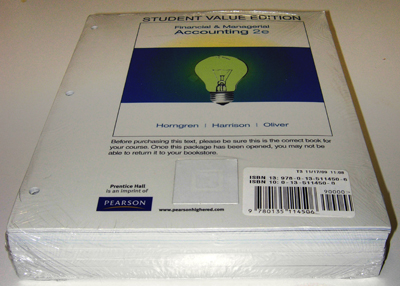
I just paid $163.50 for my accounting book. Well it wasn't a book at all. It was a package of loose pages in a shrink wrapped package. Come on! Are you serious. This package of papers is 3-inches thick. I have to put them in a huge binder that takes up even more room. How am I suppose to carry this around. I already dropped the notebook twice. The rings flew open and pages went everywhere. It doesn't fit on my desk either. My algebra book was $80+. It was loose pages also. I didn't buy it. The teacher said I could buy version 6 off of the internet. I went to Amazon.com and found version 6 with the CD. I paid $7.53 and that price included shipping. Oh yea... It was a real book too! |
Notice the writing at the top of the book. This is the Student Value Edition. |